Dr. Manmohan Singh
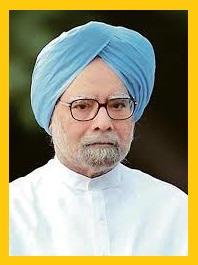
Dr. Manmohan Singh was born on 26th September 1932, Gah (Present day Pakistan) was an Indian economist and politician who served as prime minister of India from 2004 to 2014. Dr. Manmohan was the first person from a minority community to occupy the office of the Prime Minister. He was also the first prime minister after Pandit Jawaharlal Nehru to return to PMO after successfully completing a full five-year term (2004–09). Dr. Manmohan Singh served as the finance minister in P.V. Narasimha Rao’s cabinet from 1991 to 1996. The economic reforms and liberalization policies of Manmohan Singh helped our country to pull out of a severe financial crisis.
Dr. Manmohan Singh received a Bachelor’s degree in 1952 and a Masters degree in 1954 in economics from Panjab University. In 1957, Dr. Singh completed another bachelor’s in economics from the University of Cambridge. He earned a doctorate in economics from the University of Oxford in 1962. Dr. Manmohan joined Delhi School of Economics, University of Delhi, as a Professor in 1969. In the 1970s he was named in several economic advisory boards in the Government of India, including the governor of the Reserve Bank of India from 1982 to 1985. In 1991, Manmohan Singh was elected to Rajya Sabha as a member of the Indian National Congress, and served as finance minister until 1996 in the Narasimha Rao’s cabinet. At that time, Indian economy was on the verge of a collapse and steps initiated by Dr. Manmohan helped to recover from the economic crisis. As the finance minister, Dr. Singh introduced a series of economic reforms to stabilize the Indian economy in the 1991 Union Budget. Some of the reforms are devaluation of the rupee, reducing taxes, decreasing government monopoly over many industries, privatizing state-run industries, and encouraging foreign direct investment. These measures are often credited with helping in an era of high economic growth in India.
The alliance under the leadership of Congress Party – United Progressive Alliance, won the May 2004 parliamentary elections, defeating the ruling Bharatiya Janata Party front National Democratic Alliance. Congress Legislative Party leader Sonia Gandhi who is the widow of former prime minister Rajiv Gandhi, recommended Manmohan Singh for the post of PM. Dr. Singh subsequently formed a government and took office. In the parliamentary elections of May 2009, the Congress Party increased its number of seats in the Parliament, and Dr. Singh took office as prime minister for a second time. During his tenure Singh undertook landmark initiatives and faced significant challenges that shaped his legacy as the Prime Minister of India. On December 26, 2024, Dr. Manmohan Singh died at age 92 at the All India Institute of Medical Sciences in New Delhi due to age-related illnesses. He was cremated with state honours, and leaders from various parties paid tribute to Dr. Manmohan. Following his death, the Indian government declared mourning for seven days throughout the country from December 26, 2024, to January 1, 2025. Dr. Manmohan was cremated with full state honours at Nigambodh Ghat, New Delhi on December 28th, 2024.