Lal Bahadur Shastri
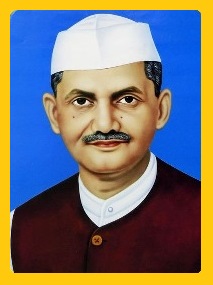
Lal Bahadur Shastri was born on October 2, 1904 at Mughalsarai, Uttar Pradesh, India was an Indian freedom fighter who served as the second prime minister of India from 1964 to 1966, after the death of Jawaharlal Nehru, India’s first prime minister. He was a prominent leader of the Indian National Congress (Congress Party), who originated the nationalist slogan “Jai jawan, jai kisan”. Posthumously, he was awarded the Bharat Ratna, the highest civilian award in India, in 1966.
Lal Bahadur Shastri was born to Sharda Prasad Srivastava and Ram Dulari Devi. His father was a school teacher and mother was a house wife. Even though Shastri was not his family name, ultimately he used it to indicate his knowledge of Hindu scriptures. In 1906, after the death of Sharda Prasad, Ram Dulari left her husband’s residence in Allahabad (Prayagraj) and moved back to her parent’s home in Mughalsarai (Uttar Pradesh), where Shastri spent much of his childhood. In the year 1917 Shastri joined the Harish Chandra High School in Benares ( Varanasi), where he was extremely influenced by Nishkameshwar Misra, one of his teachers. Misra’s support for the ongoing Indian Independence Movement implanted nationalist ideals in the young Shastri. Shastri left school in 1921, in response to Gandhiji’s call to join the national noncooperation movement, which urged all Indians to boycott educational institutions supported by the English government. Shastri joined the Congress party and during this time he was briefly imprisoned for his nationalist activities. After his release from custody he studied at the Kashi Vidyapith, a nationalist university, where he graduated and was entitled as “Shastri”. He joined the Servants of the People Society, an organization founded by Lala Lajpat Rai and devoted himself to the service of those marginalized by the caste system. Shastri married Lalita Devi in the year 1928 and continued with his social and political work, was imprisoned several times before reaching the top leadership of the Congress Party.
After Indian independence in 1947, Shastri joined the union government, first as railways minister (1951–56), and then in several other noticeable positions, including the home ministry. His administrative reforms led to the formation of the Santhanam Committee, a panel responsible for detecting corruption in various government departments and recommending appropriate solutions to stop corruption. After the death of Jawaharlal, Lal Bahadur Shastri was sworn in as India’s second prime minister in June. During his prime ministership, Shastri promoted the White Revolution – a national campaign to increase the production and supply of milk. This resulted in the establishment of Amul milk co-operative of Anand, Gujarat and the National Dairy Development Board. Shastri also promoted the Green Revolution in India in 1965 which led to an increase in food grain production, especially in the north Indian states of Uttar Pradesh, Punjab and Haryana. On 11th January 1966, Lal Bahadur Shastri died due to heart attack in Tashkent, Uzbekistan (then in the Soviet Union), one day after signing a peace treaty to end the 1965 Indo-Pakistan War. Lal Bahadur Shastri was cremated on the banks of Yamuna River and is called as Vijay Ghat, located in Delhi, near memorials of other prominent Indian leaders.